
Updated July 2026
San Francisco has a reputation as a hard city to get around, and the reason is the hills — some of the steepest graded streets in the country, concentrated in a handful of neighborhoods. But the city is also compact and has one of the deepest accessible transit networks in the western US: every Muni bus, train, and historic streetcar is wheelchair accessible, every BART station has elevators, and the whole system was designed to move people under and around the hills rather than over them. Plan around the grade and lean on the transit, and San Francisco opens up. Here’s the full picture.
In this Guide:
- Reading the City’s Terrain
- Muni — Buses, Metro & Historic Streetcars
- BART — Regional Rail
- The Cable Cars
- Ramp Taxis
- Rideshare WAVs
- SF Paratransit
- Driving & Accessible Parking
- Quick Reference
Reading the City’s Terrain
The single most useful thing to know is that San Francisco’s terrain isn’t uniform — it’s a patchwork of steep hills and genuinely flat districts.
The flat parts are flatter than people expect. The entire eastern waterfront — the Embarcadero from the Ferry Building to Fisherman’s Wharf — is level and smooth. SoMa, the Marina and Crissy Field, the Mission flatlands, Golden Gate Park’s interior, and the Civic Center area are all manageable on the level. You can build a full trip out of flat neighborhoods.
The steep hills are concentrated and predictable: Nob Hill, Russian Hill (Lombard Street), Telegraph Hill (Coit Tower), Pacific Heights, and Twin Peaks. A few sidewalks on these hit grades no manual wheelchair or cane user should attempt, and some have stairs built into the sidewalk. The move isn’t to skip these sights — it’s to arrive at them differently (transit, accessible parking, or a ramp taxi to the top) rather than climbing from below.
Mobility: Muni Metro and BART run underground beneath the steepest downtown grades, so you can cross the city without ever touching a hill. Ride through the hills, don’t climb them.
Muni – Buses, Metro & Historic Streetcars
Muni is the city’s local network, and all of it is wheelchair accessible.
The F-line historic streetcars — the vintage trolleys along Market Street and the Embarcadero to Fisherman’s Wharf — are fully wheelchair accessible (unlike the cable cars), with lift or ramp boarding. They’re the accessible way to ride a piece of San Francisco transit history.
Buses lower (kneel) and deploy ramps or lifts; each has two wheelchair securement areas, priority seating, and audio stop announcements. The fleet can lift up to 600 pounds.
Muni Metro light rail (the J, K, L, M, N, and T lines) serves downtown and the neighborhoods. All ten underground stations — Embarcadero, Montgomery, Powell, Civic Center, Van Ness, Union Square/Market, Church, Castro, Forest Hill, and Chinatown–Rose Pak — have street-to-platform elevators. The newer low-floor trains board level; at surface stops, accessible high-platform boarding islands are provided.
Hearing & Vision: Muni buses and trains have automated audio stop announcements and visual next-stop displays, so the same stop information reaches you whether you’re hard of hearing or blind.
For elevator and service status, check SFMTA’s live updates before you rely on a specific station.
BART – Regional Rail
BART is the regional system, and within the city it’s the fastest accessible way to cross town — it runs under Market Street and out to the Mission and Glen Park, and it’s the direct link to and from SFO.
- Every station has elevators (at some, you’ll use two — street-to-concourse, then concourse-to-platform), and every train has level boarding with designated wheelchair areas and green priority seats.
- See Flying into SFO for the step-free airport connection.
Check Elevators First:
Elevator outages do happen. Check status before you travel at (510) 834-LIFT. If an elevator is down when you arrive, the Station Agent will help you find another way in or out, or an alternative.
The Cable Cars — and the Accessible Alternatives
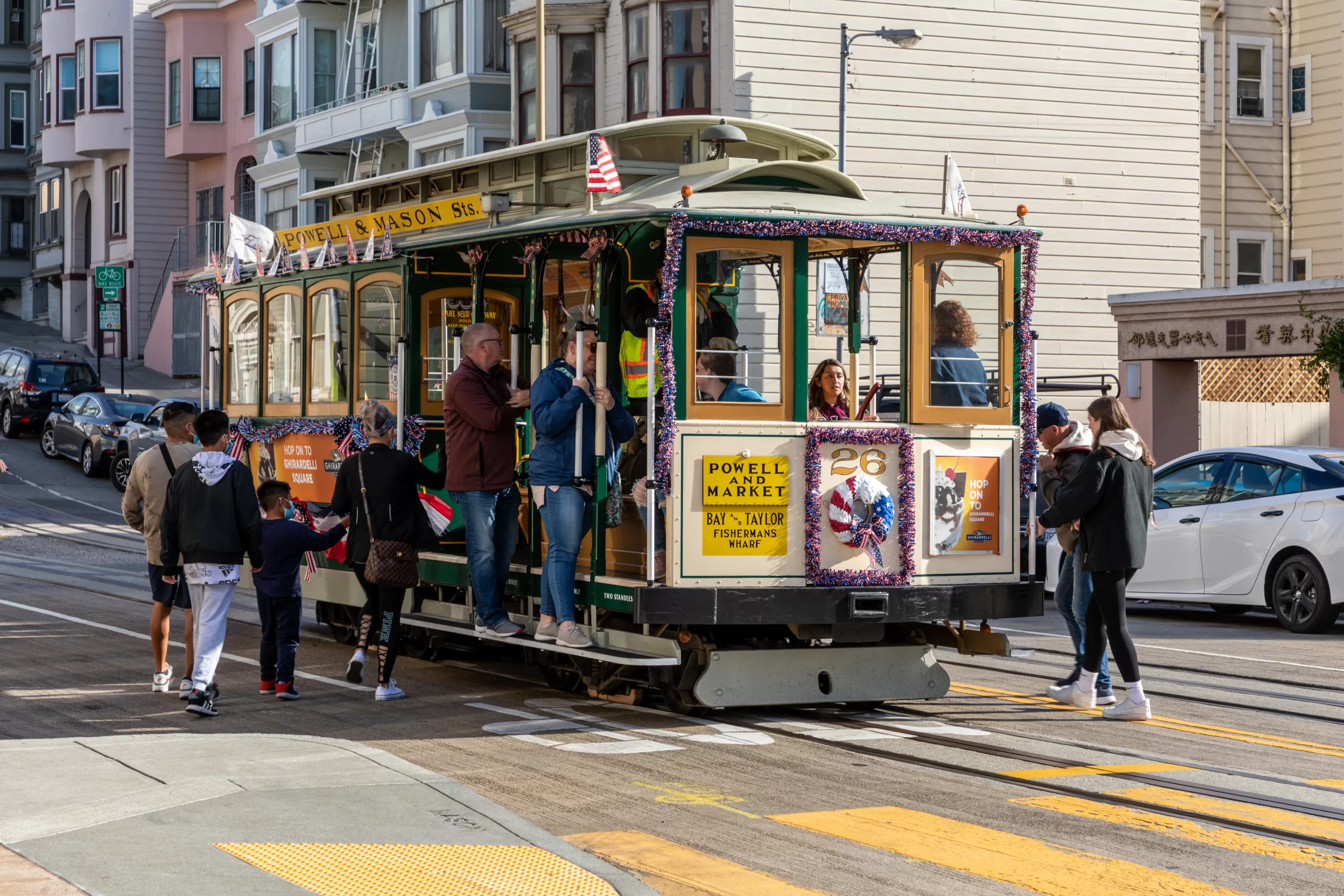
San Francisco’s three cable car lines are original 1870s equipment — and how accessible they are depends entirely on which access need you’re planning around.
Mobility — not step-free: The cable cars are not wheelchair accessible. You board by climbing steps, and a wheelchair, scooter, or walker can’t fit aboard — there’s no lift or ramp option on the cars themselves. If step-boarding is a barrier for you, use the alternatives below.
If steps aren’t a barrier for you, the cable cars are completely open to ride and worth doing. They’re open-air with handrails, the conductors call stops.
Sensory: Quieter early-morning runs are the calmest if you’re sensory-sensitive, and the Powell-Hyde line has the most scenic descent.
For wheelchair and scooter users, two satisfying alternatives capture the same experience:
- The F-line historic streetcars are fully accessible and scratch the same vintage-transit itch — restored 1900s trolleys running the flat waterfront and Market Street.
- The Cable Car Museum (free, step-free inside) on Nob Hill lets you watch the actual cable mechanism that hauls the cars and see historic cars up close. See the Landmarks guide.
Ramp Taxis
Wheelchair-accessible, ramp-equipped taxi vans operate citywide at standard meter rates — the same fare as a regular taxi. You can order one on demand, including at SFO, with wait times typically under 30 minutes. If you use a wheelchair and can’t transfer out of it, request a ramp taxi specifically; the driver will secure your chair.
For the Hilltop Sights:
For the steepest destinations (Nob Hill, Coit Tower, Twin Peaks), a ramp taxi to the door is often the most flexible option — it solves the grade for you in one step.
Rideshare WAVs
Uber and Lyft both offer wheelchair-accessible vehicle (WAV) options in San Francisco, but the supply is thinner than ramp taxis — you may wait longer, and one isn’t always minutes away. For a guaranteed accessible ride, a ramp taxi or pre-booked accessible van is the surer bet; treat rideshare WAV as a convenient option when it’s available rather than your only plan.
SF Paratransit
If you can’t use Muni’s accessible buses and trains some or all of the time because of a disability, SF Paratransit is the city’s van-and-taxi program — a shared, door-to-door service.
- Eligibility is functional, not automatic: you must be unable to use the accessible fixed-route system, or unable to get to and from a stop, some or all of the time. You apply and are assessed.
- The program includes a ramp-taxi option for same-day, direct trips — generally arriving within 30 minutes — once you’re determined ADA-eligible.
- Apply ahead of your trip: pick up an application at the SF Paratransit office (68 12th St., weekdays 9:00–4:45) or call 415-351-7000.
From Out of Town?
If you’re already certified for ADA paratransit in another city, SF Paratransit can often arrange visitor service — contact them before you travel.
Driving & Accessible Parking
Driving is the least appealing option in San Francisco — parking is scarce, expensive, and the hills make it stressful — but it’s sometimes the right call for the steepest destinations.
- A disabled placard or plate works statewide in California; with a valid placard you can park in blue accessible zones, and at most metered spaces (confirm current city rules, which change).
- Many major attractions have accessible parking near a step-free entrance — the Music Concourse Garage in Golden Gate Park, the Pier 39 garage, the Civic Center and Performing Arts garages, and the summit lot at Twin Peaks among them.
- For the steep sights, drive to the destination’s own accessible lot or use a ramp taxi, rather than parking at the bottom of a hill and approaching on foot.
Quick Reference
| To… | Use | Notes |
|---|---|---|
| Cross town under the hills | BART or Muni Metro | All stations have elevators; check status first |
| Ride the flat waterfront | F-line streetcar or Muni bus | Fully accessible; vintage trolleys on the F |
| Reach a steep hilltop sight | Ramp taxi or accessible parking | Don’t approach uphill on foot |
| Get a guaranteed accessible ride | Ramp taxi (citywide, meter rate) | On demand, usually under 30 min |
| Get to/from SFO step-free | BART (+free AirTrain) | ~30 min to downtown |
| Ride a cable car | Open to most riders; not step-free | Wheelchair users: F-line + Cable Car Museum |
The short version: ride the accessible transit through and around the hills, save a ramp taxi for the steep destinations, and you rarely need to fight the terrain at all.
Prices, delivery areas, and availability change, and Only Everywhere isn’t affiliated with any company listed here — always confirm details directly with the provider before you book.
Related:
Mobility Rentals in San Francisco
Know a great accessible spot? Help others find it. Add a Listing